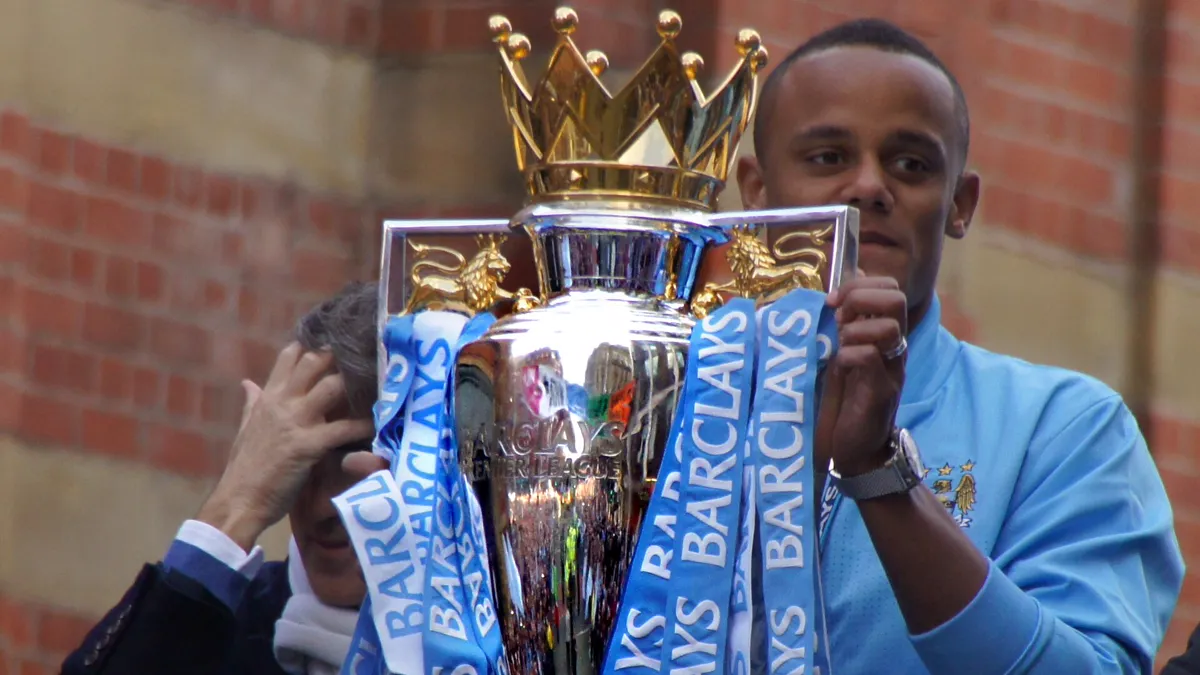
The Premier League tiebreaker rules decide league positions when teams finish level on points. Goal difference comes first, then goals scored, then head-to-head points, then away goals in the head-to-head matches, and finally a one-off play-off at a neutral venue. But the last three steps only apply when the title, a European place or relegation is at stake.
That last detail is the part most explainers get wrong. For most of the table, teams that finish level on points, goal difference and goals scored simply share the same position, and the order you see on screen is alphabetical. This guide explains the full order step by step, works through the famous title races it decided, and shows the six level pairs in the current table. See the Premier League standings for the live table, and the football live score page for today’s matches.
Premier League tiebreaker rules in order
The Premier League tiebreaker rules work in a fixed order. Each step applies only if the one before it cannot separate the clubs. The first two steps apply to every level finish. The last three come from Rule C.17 of the Premier League Handbook, and they only decide positions that matter for the title, European qualification or relegation.
| Step | Tiebreaker | What it compares | When it applies |
|---|---|---|---|
| 1 | Goal difference | Goals scored minus goals conceded across all 38 games | Any level finish |
| 2 | Goals scored | Total goals scored in the season | Still level after goal difference |
| 3 | Head-to-head points | Points won in the two games between the tied clubs | Only for the title, a European place or relegation |
| 4 | Away goals in head-to-head | Goals scored as the visiting club in those games | Same as step 3 |
| 5 | Play-off | One match at a neutral venue | Same as step 3, only if steps 1 to 4 fail |
Rule C.7 of the Handbook adds the part most lists leave out. Clubs level on points, goal difference and goals scored are deemed to occupy the same position. Head-to-head is not even consulted for a mid-table tie.
Goal difference comes first
Goal difference is goals scored minus goals conceded across the whole season. A team that scores 70 and concedes 30 has a goal difference of +40. It rewards attacking football across all 38 games, not just results against one rival, which is why the Premier League tiebreaker rules put it first.
The only Premier League title decided on goal difference came in 2011-12. Manchester City and Manchester United both finished on 89 points. City scored 93 and conceded 29 for a goal difference of +64. United scored 89 and conceded 33 for +56. Sergio Aguero’s goal in the fourth minute of stoppage time against Queens Park Rangers on the final day, 13 May 2012, made City champions for the first time in 44 years.
Goal difference is already at work this season. After Matchweek 10, Chelsea and Everton both have 16 points, but Chelsea sit fifth and Everton sixth because Chelsea’s goal difference is +3 and Everton’s is +2.
Goals scored is the second tiebreaker
If goal difference is level too, the club with more goals scored finishes higher. A tight defence gets no extra credit at this stage. Under the Premier League tiebreaker rules, goals scored is the second step, and the rule rewards the team that scored more.
The only time the English top flight was decided on goals scored came in 1988-89, before the Premier League began. Arsenal and Liverpool both finished on 76 points with a goal difference of +37 each. Arsenal won the title because they had scored 73 goals to Liverpool’s 65. The final game, at Anfield on 26 May 1989, saw Arsenal win 2-0 through Alan Smith and Michael Thomas, with Thomas scoring in the final seconds.
No Premier League title has ever been decided on goals scored. The step can still decide European places and relegation, where one goal can change a club’s season.
Head-to-head points only decide big positions
If the clubs are still level after goal difference and goals scored, the Premier League looks at the two games between them. The club that won more points in those matches finishes higher. Take a simple example: Club A beat Club B 2-1 at home and drew 1-1 away. Club A takes four head-to-head points to Club B’s one, so Club A finishes higher.
| Club | Home result | Away result | Head-to-head points |
|---|---|---|---|
| Club A | Won 2-1 | Drew 1-1 | 4 |
| Club B | Drew 1-1 | Lost 1-2 | 1 |
Here is the catch. The Premier League tiebreaker rules only bring head-to-head in when the title, a European place or relegation cannot be decided. That is Rule C.17 of the Handbook. For a mid-table tie, head-to-head is never consulted, and the clubs share the position under Rule C.7.
Most explainers list head-to-head as a plain third step. That is wrong. In the Premier League, goal difference and goals scored come first for every position, and head-to-head only enters when something big is on the line.
Away goals in head-to-head matches
If head-to-head points are level too, the next step counts away goals, but only from the two games between the tied clubs. Goals scored away from home in other matches do not count.
Another example: Club A beat Club B 2-1 at home, and Club B beat Club A 1-0 at home. Both clubs have three head-to-head points. Club B scored one goal away from home, while Club A scored none, so Club B finishes higher.
If the away goals are level as well, and the position decides the title, a European place or relegation, the final step is the play-off.
The play-off that has never happened
The Premier League tiebreaker rules end with a play-off. It is a one-off match at a neutral venue, and the Premier League Board sets the format, the timing and the venue. It only applies when the title, a European place or relegation is at stake and every other tiebreaker has failed.
It has never happened. The Premier League’s own pages state that no play-off has ever been needed in the competition’s history. It exists as a final safety net, not as a regular fixture.
What happens when teams are level mid-table?
When teams finish level on points, goal difference and goals scored, and nothing big is at stake, they share the position. Rule C.7 says they “shall be deemed to occupy the same position in the League Table”. The table still has to list one above the other, so it uses alphabetical order as a display convention.
It happened earlier this season. After five matches, Chelsea and Liverpool both had 13 points, a goal difference of +11 and 12 goals scored. They were joint-top, and Chelsea were listed first only because C comes before L in the alphabet.
Alphabetical order never decides a final position. At the end of the season, a tie that matters goes to head-to-head points, then away goals, then the play-off.
Premier League tiebreaker rules in 2026-27
The Premier League tiebreaker rules are already shaping this season’s table. After Matchweek 10, six pairs of clubs sit level on points, and every one of them is separated by goal difference alone. No pair has needed goals scored yet.
| Teams | Points | What separates them |
|---|---|---|
| Chelsea (5th) vs Everton (6th) | 16 | Goal difference: +3 vs +2 |
| Brentford (8th) vs Leeds United (9th) | 14 | Goal difference: +5 vs +2 |
| Tottenham Hotspur (11th) vs Newcastle United (12th) | 12 | Goal difference: -1 vs -3 |
| Hull City (13th) vs Ipswich Town (14th) | 11 | Goal difference: 0 vs -5 |
| Nottingham Forest (16th) vs Coventry City (17th) | 9 | Goal difference: -4 vs -9 |
| Manchester United (18th) vs Sunderland (19th) | 8 | Goal difference: -5 vs -9 |
At the top, Arsenal lead with 27 points after Matchweek 10, five clear of Brighton on 22, with Manchester City third on 21. Matchweek 11 starts on Saturday 21 November, and this page updates after every round.
Last updated: 17 November 2026, after Matchweek 10.
How other leagues decide a tie
England’s order is not universal. In Spain’s La Liga and Italy’s Serie A, head-to-head records separate level clubs before goal difference is even considered. Serie A added a rule in 2022 that a title or relegation tie goes to a one-off play-off, with the club holding the better goal difference earning home advantage.
In the Champions League, teams are separated by points, then goal difference, goals scored, away goals scored, number of wins and finally number of away wins. There is no play-off at the end of the league phase.
The Premier League’s order rewards the whole season first. Goal difference and goals scored cover all 38 games, while head-to-head covers only two. That is why a club can lose both games against a rival and still finish above them.
FAQs
What is the first tiebreaker in the Premier League?
Goal difference. If two or more clubs finish level on points, the club with the better goal difference, goals scored minus goals conceded, finishes higher.
Does head-to-head come before goal difference?
No. Goal difference comes first, then goals scored. Head-to-head points only apply after those two, and only when the title, a European place or relegation is at stake.
Has a play-off ever decided the Premier League?
No. The play-off has never been needed in the Premier League’s history. It exists only as a final step for a tie that decides the title, a European place or relegation.
What happens if teams finish level on everything?
If the position does not decide anything big, the clubs share the position under Rule C.7, and the table lists them alphabetically. If it does matter, head-to-head points, then away goals, then a play-off decide it.
Who won the Premier League on goal difference?
Manchester City in 2011-12. City and Manchester United both finished on 89 points, and City’s goal difference of +64 beat United’s +56.
Why are two teams shown in alphabetical order?
When clubs are level on points, goal difference and goals scored, they share the position. The table lists one above the other alphabetically only so the list reads in order. It does not decide anything.
Final Thoughts
The Premier League tiebreaker rules are simple once the scope is clear. Goal difference and goals scored decide every tie. Head-to-head points, away goals and the play-off only enter when the title, a European place or relegation is on the line. And if nothing is on the line, the clubs simply share the position.
Check the Premier League standings for the live table and the football live score page for today’s matches.
Sources: Premier League | BBC Sport