
How does tennis scoring work? Points win games, games win sets, and sets win the match. Inside one game the points are called love, 15, 30 and 40. Win four points and you win the game, unless both players reach 40, when the game goes to deuce. Win six games and you win the set, unless the set reaches 6-6, when a tiebreak decides it.
That sounds strange the first time you hear it, and it is. No other major sport counts like this. But once you see the three layers, points, games, sets, every scoreline reads the same way. This guide explains each layer, works through a real scoreline, and covers the Grand Slam final-set rule that changed in 2022. See the tennis live score page for today’s matches while you read.
How does tennis scoring work in short
How does tennis scoring work at a glance? A player wins a game by winning four points, with a two-point lead. A player wins a set by winning six games, with a two-game lead. A player wins the match by winning two sets in a best-of-three match, or three sets in a best-of-five match.
The table below is the whole system in one place. Everything after this section just fills in the detail.
| Layer | What you need to win it | How it is counted |
|---|---|---|
| Point | 1 rally | Love, 15, 30, 40, game |
| Game | 4 points, by 2 | Games, 0 to 6 and beyond |
| Set | 6 games, by 2 | Sets, 0 to 2 or 0 to 3 |
| Match | 2 sets (best of 3) or 3 sets (best of 5) | Sets won |
Points in a game: love, 15, 30, 40
A standard game starts at love-all, which means 0-0. The first point a player wins is called 15, the second 30, and the third 40. Win a fourth point and you win the game, as long as your opponent has won two points or fewer.
The server’s score is always called first. So 30-15 means the server has won two points and the receiver has won one, whoever is leading the set. The score is called from the server’s side, every time.
| Points won | What the umpire calls |
|---|---|
| 0 | Love |
| 1 | 15 |
| 2 | 30 |
| 3 | 40 |
| 4, with the other player on 2 or fewer | Game |
A game can be over in four points: love, 15, 30, 40, game. That is the fastest possible game. Most games last longer, because the receiver wins points too, and then the game reaches the score every new fan asks about.
Deuce and advantage
When both players have won three points, the score is 40-40. That score is called deuce. From deuce, a player must win two points in a row to win the game.
Win the next point after deuce and you have advantage. Win the point after that and the game is yours. Lose the advantage point and the score goes back to deuce, and the fight starts again. A single game can go through deuce many times.
| Score after deuce | What it means |
|---|---|
| Deuce | 40-40, both players on three points |
| Advantage server | Server won the point after deuce |
| Advantage receiver | Receiver won the point after deuce |
| Back to deuce | The player with advantage lost the next point |
This is why a game can last two minutes or ten. The player who wins the game is not always the one who won more points in it. A game that goes to deuce five times has 16 points in it, and the winner only needs two more than the loser at the end.
Games become sets
A set is won by the first player to win six games, with a lead of at least two games. Scores like 6-0, 6-3 and 6-4 all end a set at once. At 5-5, a player can win the next two games and take the set 7-5. At 6-6, the set is decided by a tiebreak, and the set finishes 7-6.
That two-game lead is the part people miss. Winning six games is not enough on its own. At 6-5, the set goes on. The leader must win one more game for 7-5, or the set reaches 6-6 and the tiebreak takes over.
| Games score | What happens |
|---|---|
| 6-0, 6-1, 6-2, 6-3, 6-4 | Set over, leader wins |
| 5-5 | Set goes on |
| 7-5 | Set over, leader won two in a row |
| 6-6 | Tiebreak decides the set, 7-6 |
There is one older format worth knowing. In an advantage set, there is no tiebreak at 6-6, and play goes on until one player leads by two games. You will still see it in a few events, but the tiebreak set is the norm in almost all professional tennis today.
How a tiebreak works
A tiebreak decides a set at 6-6. The points in a tiebreak are counted in plain numbers: 0, 1, 2, 3, and so on. There is no 15, 30 or 40 in a tiebreak. The first player to win seven points, with a two-point lead, wins the tiebreak and the set.
At 6-6 in tiebreak points, seven is no longer enough. Play goes on until one player leads by two, so tiebreaks can finish 8-6, 9-7, or further. The set score is always written 7-6, whatever the tiebreak points were.
Serving works differently in a tiebreak too. The player due to serve serves the first point. Then the other player serves the next two points. After that, service changes every two points. Players change ends after every six points in the tiebreak.
| Tiebreak points | Result |
|---|---|
| 7-0 to 7-5 | Tiebreak over, leader wins the set 7-6 |
| 6-6 | Play goes on, leader needs two clear points |
| 8-6, 9-7, 10-8 | Tiebreak over, leader wins the set 7-6 |
Final-set tiebreaks at the Grand Slams
The final set at a Grand Slam works differently from the sets before it. Since 2022, all four majors (the Australian Open, Roland-Garros, Wimbledon and the US Open) play a 10-point tiebreak at 6-6 in the final set. The first player to 10 points, with a two-point lead, wins the match.
The Grand Slam Board announced the shared rule on 16 March 2022, and it started at Roland-Garros that year. Before that, each major ended a deciding set its own way. The Australian Open had used a 10-point tiebreak since 2019. The US Open used a seven-point tiebreak at 6-6. Wimbledon used a seven-point tiebreak at 12-12. Roland-Garros had no deciding tiebreak at all, so a final set could go on for hours.
The change was made so players and fans face the same ending at every major. The sets before the final one still use the normal seven-point tiebreak at 6-6. Only the deciding set, the third set for women and the fifth set for men, uses the 10-point version.
How a match is won
A match is best of three sets or best of five sets. In a best-of-three match, the first player to win two sets wins the match. In a best-of-five match, the first player to win three sets wins the match.
Most professional matches are best of three, including all women’s singles matches and almost all men’s matches outside the Grand Slams. Men’s singles at the four Grand Slams is best of five, which is why a Grand Slam match can last five hours and a regular tour match rarely lasts three.
| Format | Sets needed to win | Where you see it |
|---|---|---|
| Best of three | 2 sets | Most tour matches, all women’s singles |
| Best of five | 3 sets | Men’s singles at the four Grand Slams |
A player who loses the first set has not lost the match. In best of three, they need the next two sets. In best of five, they can still lose the first two sets and win the last three, though that is rare.
A worked example: reading a real scoreline
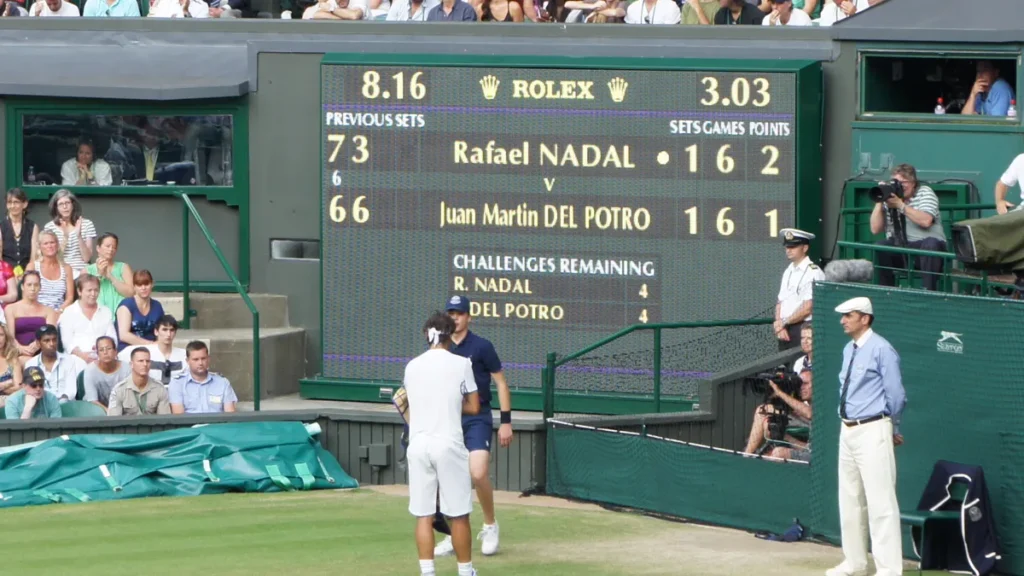
Take this scoreline: 6-4, 3-6, 7-6(7-4). Here is how to read it, set by set.
In the first set, the winner took six games to four. That is a set won at the first chance, with the two-game lead. In the second set, the other player won six games to three, so the match was level at one set each. In the third set, neither player could build a two-game lead, so it reached 6-6 and went to a tiebreak. The number in brackets is the tiebreak score: 7-4 in points. So the set finished 7-6, and the match finished two sets to one.
The bracket only ever appears on a 7-6 set. If you see 7-6(7-5), the tiebreak went to 7-5 in points. If you see 7-6(11-9), the tiebreak went long, past 6-6 in points, until one player led by two.
No-ad scoring and match tiebreaks
Not every match uses the scoring above. Some events use approved shorter formats, and they must be announced before the event starts.
In no-ad scoring, there is no advantage after deuce. At 40-40, one deciding point wins the game, and the receiver chooses which side to receive from. You will see no-ad scoring in some doubles events and lower-level competitions.
In a match tiebreak, the deciding set is replaced by one tiebreak, usually to 10 points with a two-point lead. When the match is one set all, the 10-point tiebreak decides the match instead of a full third set. This is common in doubles and in some team events, where it keeps matches shorter.
These are exceptions, not the standard game. If an event uses them, it says so in advance. The scoring in this guide is the standard game used in singles at almost every professional event.
Common mistakes when reading the score
New fans make the same few mistakes with tennis scoring. They are easy to fix once you see them.
First, 40-40 is deuce, not 40-all. Second, tiebreak points are plain numbers, not 15, 30 and 40. Third, the server’s score is called first, so 40-15 and 15-40 are opposite scores, not the same one. Fourth, a set score of 7-6 always means a tiebreak was played. And fifth, winning more points in a match does not always mean winning the match. A player can win more points overall and still lose, because points only count inside games, and games only count inside sets.
Frequently Asked Questions
Why is zero called love in tennis?
The usual story traces love to the French word l’oeuf, meaning egg, for the shape of a zero. That is the story most guides tell, but the rulebook does not state an origin, so it is best read as tradition rather than fact. What the rules do say is that no point is called love, and the server’s score comes first.
How many points do you need to win a game?
Four points, with a two-point lead. If your opponent has won two points or fewer, the fourth point wins the game. If both players reach three points, the score is deuce, and you need two points in a row from there.
What is a tiebreak in tennis?
A tiebreak is a game played at 6-6 in games to decide the set. Points are counted 0, 1, 2, 3 and so on, and the first player to seven points with a two-point lead wins the tiebreak and the set 7-6. In the final set at a Grand Slam, the tiebreak goes to 10 points instead of seven.
How many sets do you need to win a tennis match?
Two sets in a best-of-three match, and three sets in a best-of-five match. Most matches are best of three. Men’s singles at the four Grand Slams is best of five.
What does 7-6(7-4) mean in tennis?
It means the set was decided by a tiebreak. The set score was 7-6 in games, and the tiebreak score was 7-4 in points. The number in brackets is always the tiebreak points, and it only appears on a 7-6 set.
Why do the Grand Slams use a 10-point tiebreak?
Since 2022, all four Grand Slams play a 10-point tiebreak at 6-6 in the final set, so every major ends a match the same way. Before that, each major had its own ending, from no tiebreak at Roland-Garros to a tiebreak at 12-12 at Wimbledon. The earlier sets still use the normal seven-point tiebreak.
Final Thoughts
Tennis scoring looks strange because it counts in three layers at once, and the numbers inside a game, love, 15, 30, 40, do not look like counting at all. But the layers are simple once they are separated. Points win games, games win sets, and sets win the match. Deuce and the tiebreak are the only places where the win-by-two rule stretches a game or a set out, and the Grand Slam 10-point tiebreak is the only place where the final set breaks the pattern.
Next time you watch a match, follow one game from love-all to game, then one set from 0-0 to 6-4 or 7-6. After that, the scoreboard will read itself. Check the tennis live score page for the next match and try it live.
Sources: ITF Rules of Tennis and Grand Slams jointly adopt 10-point final-set tiebreak, 16 March 2022.