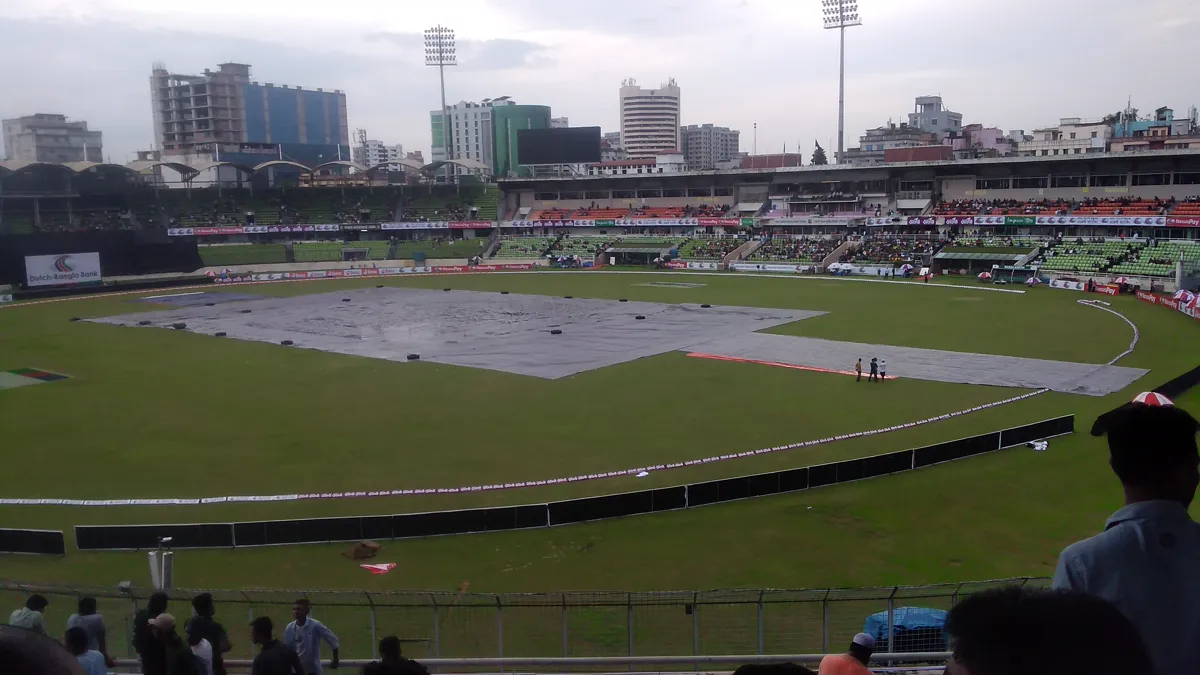
Rain is part of cricket, and when it shortens a limited-overs match someone has to decide what the chasing team now needs. Since the late 1990s that job has been done by a mathematical system: first the Duckworth-Lewis method, and today the Duckworth-Lewis-Stern (DLS) method. You will see “DLS” next to targets and results on scorecards worldwide, including our cricket live score pages. This guide explains how it works without the heavy maths.
Where DLS came from
The method was devised by English statisticians Frank Duckworth and Tony Lewis and first used in international cricket in the late 1990s. It replaced older systems such as “most productive overs”, which produced some famously unfair targets. Australian statistician Steven Stern later took over the method’s development and updated it for modern, higher-scoring cricket, and his name was added — giving us Duckworth-Lewis-Stern. It is the official method used by the ICC for interrupted one-day and T20 internationals.
The big idea: “resources”, not just overs
Older systems only looked at overs. The key insight of DLS is that a batting side has two resources to make runs with:
- Overs remaining, and
- Wickets in hand.
Ten overs left with nine wickets in hand is worth far more than ten overs left with one wicket in hand — the first team can attack freely, the second must be careful. DLS expresses every combination of overs and wickets as a percentage of total resources. A full innings with all ten wickets is 100%. As overs are used and wickets fall, the remaining percentage drops.
How the target is adjusted
When overs are lost, DLS compares the resources each team had (or will have) available:
- If the team batting second has fewer resources than the team batting first — for example because rain shortened their innings — their target is reduced in proportion.
- If the team batting first was interrupted and lost resources, but the chasing team gets a full allocation of its shortened innings, the target can actually go up. That is why you sometimes see a target higher than “first-innings score plus one” in a rain-shortened match.
Because losing wickets also uses up resources, DLS rewards a team that has kept wickets in hand. Two chases on exactly the same score after the same number of overs can face very different revised targets if one has lost two wickets and the other seven.
What is a “par score”?
During a chase, broadcasters show a DLS par score. It is the score the chasing team needs to have at that moment — for the number of overs bowled and wickets lost — to be exactly level if no more play is possible. If play is abandoned:
- above par → the chasing team wins;
- below par → the team batting first wins;
- exactly on par → the match is tied.
That is why captains watch the par score closely when dark clouds arrive, and why a chasing team will sometimes take extra risks to get ahead of par before the rain.
Minimum overs for a result
DLS can only produce a result if both teams have had a reasonable amount of batting. Under standard ICC playing conditions, the team batting second must face at least 20 overs in an ODI and 5 overs in a T20 (unless they have already reached the target or been bowled out). If that minimum is not reached, the match is a no result. Individual tournaments can set their own minimums in their playing conditions.
Professional and Standard editions
There are two versions. The Professional Edition runs on software and is used in international and top-level professional cricket; it is more accurate for high-scoring games. The Standard Edition uses published resource tables and can be worked out with a calculator, which makes it practical for club and school cricket.
Why DLS is considered fair
- It values wickets. Simple run-rate methods ignored wickets completely, so a team that had collapsed could still be set an easy target.
- It handles interruptions at any point. Rain in the first innings, the second innings or both can all be handled consistently.
- It is updated. The model is periodically recalibrated using recent match data, so it reflects modern scoring patterns.
It is not perfect — no model can know how a specific team on a specific pitch would have batted — but it removes the most obvious unfairness of older systems, which is why it has lasted for decades.
A simple illustration
Imagine Team A bats its full 50 overs and makes 260. Before Team B starts, rain reduces their innings to 40 overs. Team B has the same ten wickets but fewer overs, so it has fewer resources than Team A had. Under DLS its target becomes lower than 261 but higher than a simple run-rate calculation would suggest, because with ten wickets and only 40 overs Team B can bat more aggressively than in a full 50-over chase. The exact figure comes from the DLS software or tables on the day.
Frequently asked questions
Is DLS used in Test cricket?
No. Test matches have no fixed overs per innings, so time lost to rain simply reduces the chance of a result; there is no target adjustment.
Can the DLS target be higher than the first-innings score?
Yes. If the team batting first lost overs to an interruption and the chasing team is not similarly restricted, the revised target can be higher than the first-innings total plus one.
Do T20 leagues like the PSL and IPL use DLS?
Yes. Rain-affected matches in the major T20 leagues are decided using DLS under each tournament’s playing conditions. You can follow revised targets live on our PSL and IPL pages.