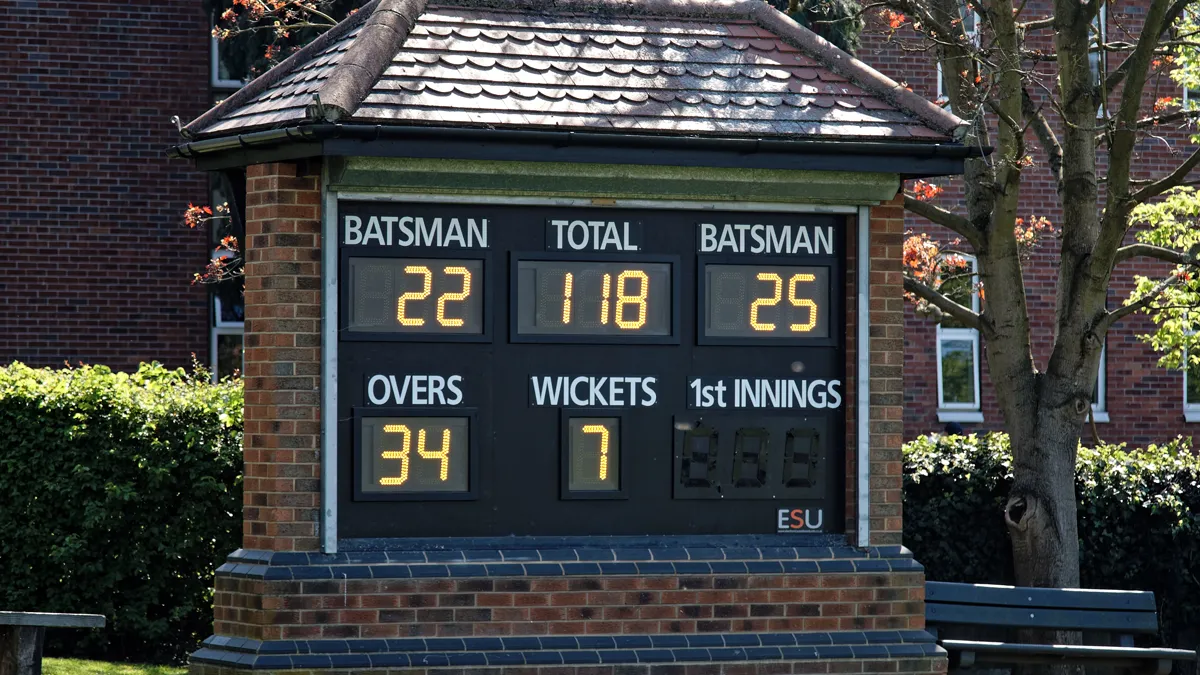
A cricket scorecard can tell the whole story of a match in a few lines — who batted well, who was out cheaply, which bowler turned the game and where the collapse happened. But for new fans it looks like a wall of letters and numbers. This guide explains every part of a standard scorecard, the same layout you see on our cricket live score pages.
The batting card
Here is a sample T20 innings:
| Batter | Dismissal | R | B | 4s | 6s | SR |
|---|---|---|---|---|---|---|
| Opener A | c Keeper b Bowler X | 45 | 30 | 5 | 2 | 150.00 |
| Opener B | lbw b Bowler Y | 12 | 10 | 2 | 0 | 120.00 |
| Batter C | run out (Fielder Z) | 8 | 6 | 1 | 0 | 133.33 |
| Batter D | not out | 60 | 38 | 4 | 4 | 157.89 |
| Batter E | not out | 20 | 12 | 1 | 1 | 166.67 |
What the columns mean
- R — runs scored by the batter.
- B — balls faced. Wides do not count as balls faced; no-balls do.
- 4s / 6s — boundaries hit.
- SR — strike rate: runs per 100 balls. Calculated as R ÷ B × 100. Batter D: 60 ÷ 38 × 100 = 157.89.
- Some cards add M — minutes at the crease — mostly in Test cricket.
Dismissal abbreviations
- b Bowler — bowled.
- c Fielder b Bowler — caught by the fielder off that bowler.
- c & b Bowler — caught by the bowler off their own delivery.
- c †Keeper — the dagger (†) marks the wicketkeeper; the asterisk (*) marks the captain.
- lbw b Bowler — leg before wicket (see our LBW rule guide).
- st †Keeper b Bowler — stumped.
- run out (Fielder) — no bowler is credited.
- hit wicket b Bowler — the batter broke their own stumps.
- retired hurt / retired out — the batter left the field; only “retired out” counts as a dismissal.
- not out — still batting at the end of the innings.
Bowled, caught, LBW, stumped and hit wicket count towards the bowler’s wickets. Run outs, obstructing the field and timed out do not.
Extras
Below the batters you will see a line such as Extras (b 1, lb 4, w 6, nb 2) 13.
- b — byes: runs taken when the ball passes the bat and body without touching either.
- lb — leg byes: runs after the ball hits the batter’s body (not the bat), when they were playing a shot or avoiding the ball.
- w — wides: a penalty run plus any runs taken.
- nb — no-balls: a penalty run; in limited-overs cricket the next ball is a free hit.
- p — penalty runs awarded by the umpires, for example for the ball hitting a fielder’s helmet left on the field.
The total
The total is shown as runs/wickets (overs), for example 158/3 (20 ov). Many countries write runs first (158/3); in Australia it is common to write wickets first (3/158). Both mean 158 runs for the loss of 3 wickets.
Next to the total you will usually see the run rate (RR) — runs per over — and, in a chase, the required run rate (RRR).
Fall of wickets (FoW)
A line like FoW: 1-58 (Opener B, 6.2 ov), 2-71 (Batter C, 8.1 ov), 3-102 (Opener A, 11.4 ov) tells you the team score when each wicket fell and in which over. It shows partnerships and collapses at a glance: here the first partnership was worth 58, the second only 13.
Did not bat
Players who did not get to bat are listed separately. In a T20, a long “did not bat” list usually means the top order did the job.
The bowling card
| Bowler | O | M | R | W | Econ | Dots | Wd | NB |
|---|---|---|---|---|---|---|---|---|
| Bowler X | 4 | 0 | 28 | 1 | 7.00 | 9 | 1 | 0 |
| Bowler Y | 4 | 1 | 22 | 1 | 5.50 | 13 | 0 | 0 |
| Bowler W | 3.4 | 0 | 41 | 0 | 11.18 | 4 | 2 | 1 |
- O — overs bowled. 3.4 means three overs and four balls.
- M — maidens: overs in which no runs were conceded off the bat or as wides/no-balls.
- R — runs conceded. Byes and leg byes are not charged to the bowler; wides and no-balls are.
- W — wickets taken.
- Econ — economy rate: runs conceded per over. Bowler W: 41 ÷ 3.667 overs = 11.18.
- Dots — balls from which no runs were scored, shown on many modern cards.
- Wd / NB — wides and no-balls bowled.
Bowling figures are often written as 4-1-22-1: overs, maidens, runs, wickets. In Test cricket you may also see a bowling average (runs per wicket) and strike rate (balls per wicket) in career stats.
Test match extras
Test scorecards show two innings per side and use a few extra terms:
- dec — declared: the captain ended the innings early.
- f/o — follow-on: the team batting second was made to bat again straight away.
- Lead / Trail — the difference between first-innings totals.
Reading a scorecard in 20 seconds
- Check the total and overs — fast or slow innings?
- Scan the R and SR columns for the top scorer and the quickest innings.
- Look at FoW for collapses.
- Find the bowler with the most wickets and the lowest economy.
- Check extras — a big number usually means a scrappy bowling performance.
Frequently asked questions
Why do wides not count as balls faced?
Because the batter could not reasonably reach them, so they are not treated as deliveries the batter faced. No-balls are within reach and do count.
What does an asterisk next to a score mean?
Next to a batter’s name it means captain. Next to a score, such as 60*, it means not out.