Offside is the most argued-about rule in football. It decides goals in every league on the planet, and since the arrival of VAR it is sometimes judged by the width of a toenail. The good news is that the rule itself is short. Once you separate being in an offside position from committing an offside offence, almost every decision makes sense.
This guide follows Law 11 of the IFAB Laws of the Game, the rulebook used by every competition from the Premier League to the World Cup.
Step 1: Is the player in an offside position?
A player is in an offside position if, at the moment a team-mate plays or touches the ball, all three of these are true:
- Any part of their head, body or feet is in the opponents’ half of the pitch (the halfway line itself does not count as the opponents’ half).
- That part is nearer to the opponents’ goal line than the ball.
- That part is nearer to the goal line than the second-last opponent.
The “second-last opponent” is usually the last outfield defender, because the goalkeeper is normally the last one. If the goalkeeper has come out, the second-last opponent could be a defender standing on the line.
The hands and arms are ignored — for both attackers and defenders. The boundary is the bottom of the armpit, so a striker cannot be offside because an arm was ahead of the defender.
Level means onside
A player who is level with the second-last opponent, or level with the ball, is not in an offside position. This is why tight decisions are drawn with lines on replays: if any scoring part of the attacker is beyond the defender’s line, it is offside; if they are level, it is onside.
Step 2: Is it actually an offence?
Being in an offside position is not an offence on its own. A player can stand offside all match and never be penalised. The referee only blows when the player becomes involved in active play by:
- Interfering with play — playing or touching the ball passed or touched by a team-mate.
- Interfering with an opponent — for example blocking the goalkeeper’s line of sight, challenging for the ball, or making an obvious action that affects an opponent’s ability to play it.
- Gaining an advantage — playing the ball after it rebounds off the post, the crossbar, the goalkeeper or an opponent, having been in an offside position when it was last played by a team-mate.
That is why you will sometimes see an attacker in an offside position next to a goal that still stands: they did not touch the ball and did not affect any defender.
When offside cannot happen
There is no offside offence if a player receives the ball directly from:
- a goal kick,
- a throw-in, or
- a corner kick.
A player also cannot be offside in their own half, or if they are behind the ball when it is played.
The deliberate-play exception
If a defender deliberately plays the ball — a controlled pass, clearance or touch, not a save and not a deflection — an attacker who was in an offside position is reset and is no longer penalised for that phase. A deliberate save by a defender (stopping a ball heading into goal) does not reset offside.
Three examples
Example 1: The through ball
A midfielder passes forward. At the moment of the pass, the striker’s shoulder is half a metre beyond the last defender. The striker runs on and scores. Offside — they were in an offside position at the moment of the pass and then played the ball.
Example 2: The player who stays out of it
A winger shoots from outside the box. A team-mate is standing in an offside position but well wide of the goalkeeper and makes no movement towards the ball. The shot goes in. Goal stands — the team-mate did not interfere with play or with an opponent.
Example 3: The rebound
A striker is in an offside position when a team-mate shoots. The goalkeeper saves, the ball rebounds, and the striker taps it in. Offside — they gained an advantage from a rebound off the goalkeeper.
What happens after an offside
The referee awards an indirect free kick to the defending team from the place where the offence happened — usually where the offside player became involved in play, even if that is in their own half.
How VAR and the assistant referee judge it
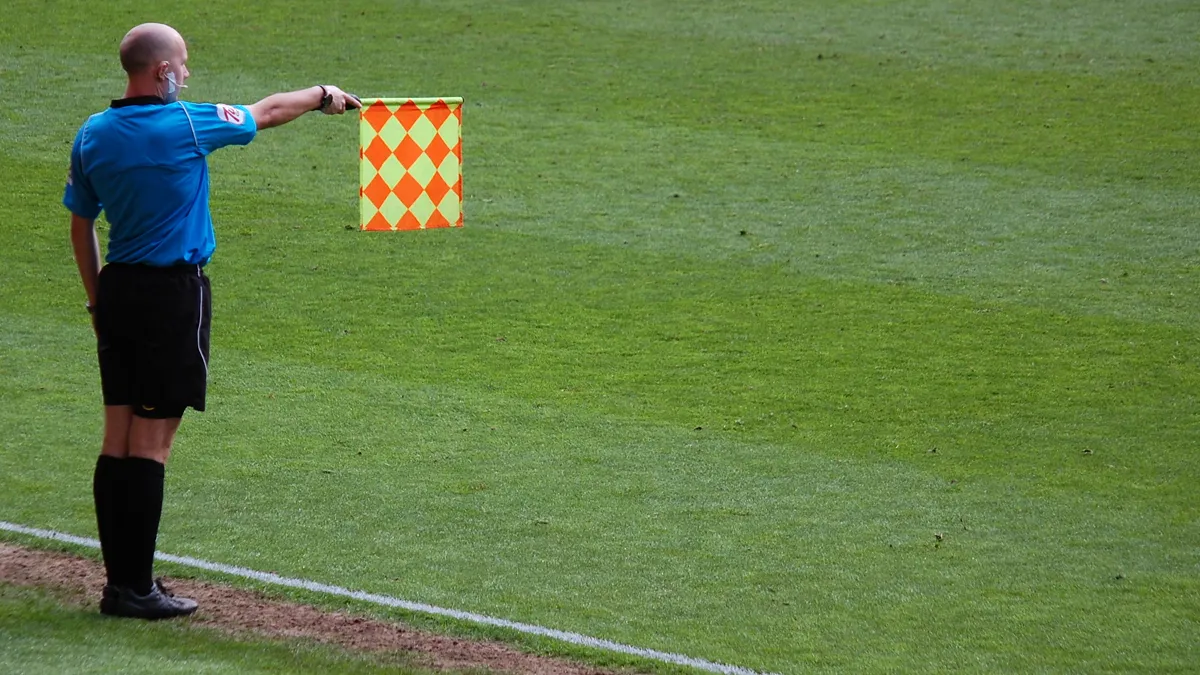
On the field, the assistant referee watches the line of the second-last defender and raises the flag. Officials are instructed to delay the flag in tight situations so that a possible goal is not wrongly stopped; VAR can then review the decision.
VAR draws lines across the pitch at the frame when the ball is played. Some competitions, including the 2022 FIFA World Cup and several European leagues, use semi-automated offside technology, which tracks players’ limbs with cameras and a sensor in the ball to produce the line faster. Whatever the technology, the question is the same one written in Law 11: was any scoring part of the attacker beyond the second-last defender when the ball was played?
Quick checklist
- Freeze the moment the team-mate plays the ball.
- Is the attacker in the opponents’ half, ahead of the ball and ahead of the second-last opponent? (Ignore arms.)
- If yes, did they then play the ball, affect an opponent, or benefit from a rebound?
- Was it from a goal kick, throw-in or corner? Then there is no offside.
Follow every Premier League, La Liga and Champions League match — and see how many goals are ruled out for offside — on our football live score page.
Frequently asked questions
Can you be offside from a throw-in?
No. A player cannot be penalised for offside when receiving the ball directly from a throw-in, goal kick or corner kick.
Does the goalkeeper count as a defender for offside?
Yes. The rule refers to the second-last opponent, who can be any player, including the goalkeeper.
Can you be offside in your own half?
No. A player has to have part of their head, body or feet in the opponents’ half to be in an offside position.