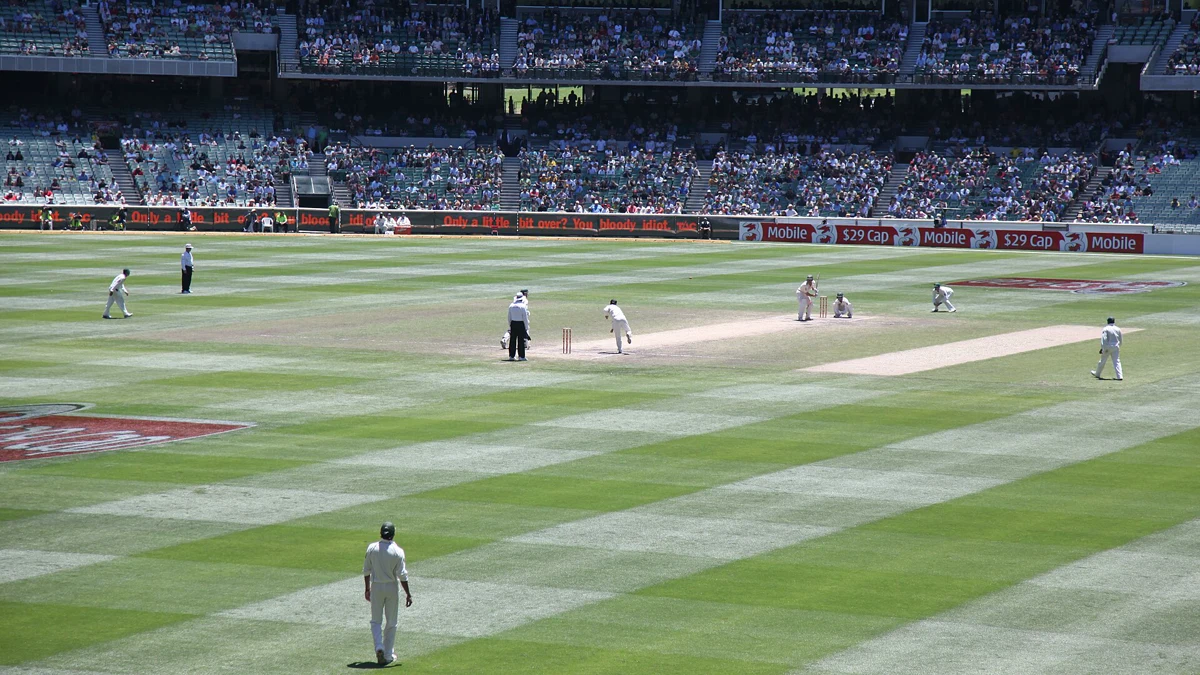
How does Test cricket work? Two teams play for up to five days, each batting twice, and the side that scores more runs while bowling the other side out twice wins. If time runs out first, the match is a draw. That is the whole game in one line. The rest of this guide explains the five days, the follow-on, declarations, the new ball and the World Test Championship, so you can follow any Test without getting lost.
India and New Zealand started the first Test of their series at the Basin Reserve in Wellington on 19 November 2026. Check the India vs New Zealand schedule for the full series dates, and the cricket live score page to follow the match live.
How does test cricket work in short
A Test match is the longest form of cricket. Two teams of 11 players each play over a maximum of five days. Each team bats twice and bowls twice, in turn. There is no limit on how many overs a team can bat, only a limit on time. A team wins by scoring more runs than the other side and bowling them out twice. If the five days end before that happens, the match is a draw, no matter how far ahead one side is.
| Part of the game | How it works in a Test |
|---|---|
| Length | Up to five days, about six hours of play a day |
| Teams | Two sides, 11 players each |
| Innings | Two per side, no over limit on an innings |
| Overs per day | At least 90 overs on days one to four |
| Ball | Red ball, pink ball in day-night Tests |
| New ball | A new ball is available after 80 overs |
| Follow-on | Enforced when the first-innings lead is 200 runs or more |
The five days: how a Test match is played
Each day has about six hours of play, split into three sessions of two hours. There is a 40-minute lunch break and a 20-minute tea break. At least 90 overs must be bowled on each of the first four days. On the last day, 75 overs must be bowled before the last hour, plus at least 15 overs in the last hour.
The match starts with the toss, held 15 to 30 minutes before play. The captain who wins the toss chooses whether to bat or bowl first. That choice matters a lot, because pitches change over five days. A fresh pitch often helps fast bowlers on day one, while a worn pitch on days four and five helps spin bowlers.
Rain and bad light can eat into playing time, and lost time is almost never made up in full. This is the first thing to understand when you ask how does test cricket work in practice: the clock is as much an opponent as the other team. A side that is behind can survive by batting out time, and weather is the most common reason a Test ends in a draw.
Test cricket is the oldest format, and it is the only one with no fixed end except time. The first Test was played in March 1877, when Australia beat England by 45 runs at the Melbourne Cricket Ground. Charles Bannerman scored the first Test century, 165 retired hurt. The format has lasted nearly 150 years because no shorter game tests a team in the same way.
| Feature | Test | ODI | T20I |
|---|---|---|---|
| Length | Up to five days | One day, 50 overs a side | About three hours, 20 overs a side |
| Innings per side | Two | One | One |
| Overs in an innings | No limit | 50 | 20 |
| Ball | Red, or pink at night | White | White |
| New ball | After 80 overs | Two new balls, one from each end | One new ball |
| Follow-on | Yes, at a 200-run lead | No | No |
| DRS reviews | Three unsuccessful per innings | Two unsuccessful per innings | Two unsuccessful per innings |
| Fielding powerplay | None | Overs 1 to 10, 11 to 40, 41 to 50 | First six overs |
Two innings a side, not one
The order of play is simple. Team A bats first, then Team B bats. Then Team A bats again, and Team B bats last. Each innings ends when ten wickets fall, when the captain declares, or when the side has no batters left.
There is no over limit on an innings, so a team can bat for two days if it wants to. The only pressure is time. A captain has to judge how many runs are enough and how much time the bowlers need to take twenty wickets.
A nightwatchman is a small part of this. When a wicket falls near the end of a day, a captain may send in a lower-order batter instead of a top-order batter, so the better batter does not have to start again the next morning. It is a defensive move, and it is unique to the long format.
What is a follow-on in Test cricket?
The follow-on is the most famous rule in Test cricket. If the side batting first leads by at least 200 runs after both teams have batted once, its captain can make the other side bat again straight away, instead of batting a second time. The side that enforces the follow-on can win the match without batting again.
The rule comes from Law 14 of the Laws of Cricket. The lead needed depends on how long the match is scheduled for.
| Match scheduled for | First-innings lead needed to enforce the follow-on |
|---|---|
| Five days or more | 200 runs |
| Three or four days | 150 runs |
| Two days | 100 runs |
| One day | 75 runs |
If the whole first day is lost, the margin drops a step, because the match is judged by the days left when play starts. A five-day Test that starts on day two needs only 150 runs.
Enforcing the follow-on is a choice, not an order. A captain may refuse it to rest tired bowlers or because the pitch is getting easier to bat on. The most famous follow-on match is Kolkata in 2001, when Australia enforced it against India and India still won, by 171 runs, after VVS Laxman scored 281 and Rahul Dravid scored 180.
Declarations: why a captain stops batting
A captain can close the innings at any time, even with wickets still in hand. This is called a declaration. The point is to leave enough time to bowl the other side out and win the match.
Declaring is a gamble. Declare too late and there is not enough time left, so the match drifts into a draw. Declare too early and the other side may chase the target down and win. The best declarations set a target that looks reachable but leaves the bowling side just enough overs to take ten wickets.
A captain can also forfeit an innings, which means giving it up without batting at all. This almost never happens in Tests, but the rule exists for matches hit hard by rain, where both sides agree to set up a result.
The new ball after 80 overs
Each innings starts with a new ball. In a Test the ball is red in daylight and pink under lights. Once 80 overs have been bowled with the old ball, the fielding captain may take a new ball. The captain does not have to take it. If the old ball is swinging in reverse, the captain will often keep it.
A new ball is harder, shinier and swings more, so it is the most dangerous time for batters. The first hour after a new ball is taken often decides a session. Bowlers also change the ball when it loses shape, but a replacement ball is never as good as a new one.
Saliva may not be applied to the ball. If the umpires believe it has been, the batting side gets five penalty runs. There is no limit on how many overs a bowler can bowl in a Test, and only two bouncers above shoulder height are allowed per over.
How a Test match is won, drawn or tied
A team wins a Test by scoring more runs than the other side and bowling them out twice. Both parts matter. A side that scores 600 runs but cannot take twenty wickets does not win. A side that bowls the other team out cheaply twice still needs to pass their total.
A draw happens when the five days run out before a result. This is the most common ending in rain-hit Tests. A side that is losing can save the match by batting out the remaining time, which is why the last day of a Test can be tense even with no result in sight.
A tie is different from a draw, and it is very rare. A tie happens when the scores finish level and the side batting last is all out. Only two Tests in nearly 150 years have ended in a tie: Brisbane in 1960 and Madras in 1986. If the scores are level but the batting side still has wickets in hand when time runs out, the match is a draw, not a tie.
DRS and umpires in Test cricket
Two on-field umpires control the match, with a third umpire for replays and a match referee for discipline. The Decision Review System, or DRS, lets each team challenge an on-field decision using ball-tracking, edge detection and slow-motion replay.
Each team gets three unsuccessful reviews per innings in a Test. A review that overturns the umpire does not count against the team, and neither does a review that stays with the umpire only because of umpire’s call. So a side that keeps getting reviews right never runs out. This is the rule most often reported wrongly: the allowance is three, not two.
Test cricket added a stop clock from October 2026. The fielding side has 60 seconds to start each over after the last one ends. The first two breaches in an innings bring warnings, and every breach after that costs five penalty runs. The count resets after each block of 80 overs.
From October 2026, a wicket in the last over of the day no longer ends play. The new batter must come in and face the remaining balls. That change closed the old escape route for the nightwatchman.
Day-night Tests and the pink ball
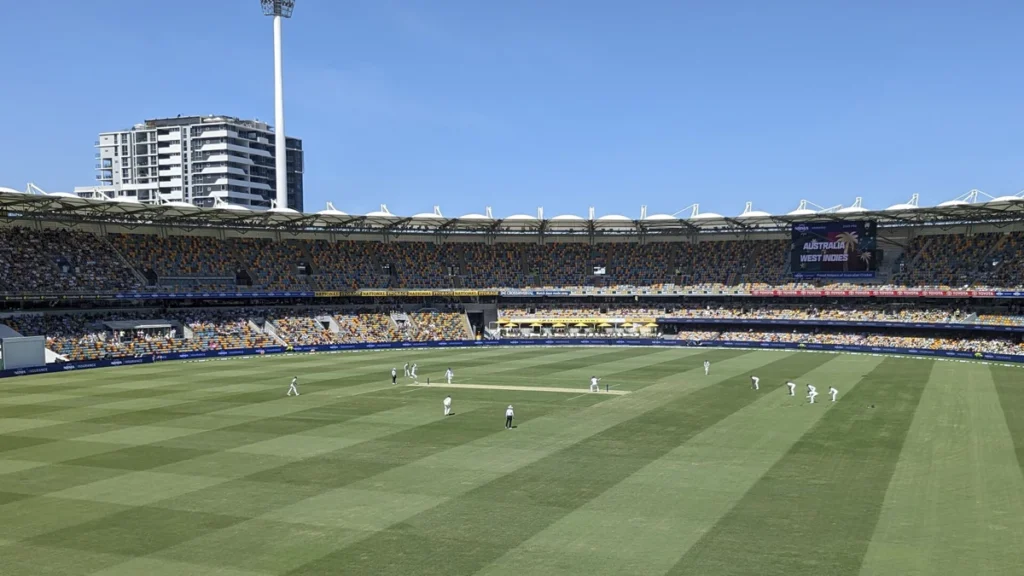
A day-night Test is played under lights with a pink ball, because a red ball is hard to see at night. The pink ball behaves much like the red one, but it can swing more under lights and it is easier for fielders to spot.
The first day-night Test was played at Adelaide in 2015, between Australia and New Zealand. Sessions run later into the evening, and the main break is dinner rather than lunch. From October 2026, teams can also agree to use a pink ball in a daytime Test, as a trial.
Day-night Tests are still a small share of the calendar. Most Tests are played in daylight with a red ball, starting in the morning and ending in the evening.
Test cricket and the World Test Championship
The World Test Championship, or WTC, gives Test cricket a league and a final. Nine teams play in the 2025 to 2027 cycle. Each team plays six series, three at home and three away, across 27 series and 71 matches. Ireland, Zimbabwe and Afghanistan play Test cricket but are not in the championship.
Points are simple. A win is worth 12 points, a tie is worth 6, a draw is worth 4, and a loss is worth none. A team loses one point for every over it falls short on over-rate. Teams are ranked by the percentage of points they won, not by total points, because teams do not all play the same number of matches.
| Result | Points |
|---|---|
| Win | 12 |
| Tie | 6 |
| Draw | 4 |
| Loss | 0 |
The top two teams meet in the final. The 2027 final will be played at The Oval in London from 9 to 13 June 2027, with 14 June kept as a reserve day. It will be the fourth final. New Zealand won the first in 2021 at Southampton, Australia won in 2023 at The Oval, and South Africa won in 2025 at Lord’s. The 2027 final also marks 150 years of Test cricket.
Frequently Asked Questions
How long does a Test match last?
A Test match is scheduled for up to five days, with about six hours of play each day. It can end sooner if one side wins inside five days, and it often does. A match that is still going after five days ends in a draw.
Why do Test matches end in a draw?
A Test ends in a draw when the five days run out before either side has won. The most common reason is rain, which eats into playing time. A side that is behind can also save the match by batting out the remaining overs without losing all ten wickets.
What is a follow-on in Test cricket?
A follow-on happens when the side batting first leads by at least 200 runs after both teams have batted once. Its captain can then make the other side bat again immediately, instead of batting a second time. The side enforcing the follow-on can win without batting again.
How many overs are bowled in a day of Test cricket?
At least 90 overs must be bowled on each of the first four days. On the last day, 75 overs must be bowled before the last hour, plus at least 15 overs in the last hour. Bad light and rain can cut the number, and the overs are made up only if the umpires extend play.
What is the difference between a draw and a tie in Test cricket?
A tie happens when the scores finish level and the side batting last is all out. Only two Tests have ever ended in a tie. A draw happens when time runs out before a result, even if the scores are level, as long as the batting side still has wickets in hand.
Do all Test matches count towards the World Test Championship?
No. Nine teams play in the World Test Championship: Australia, India, England, South Africa, New Zealand, Pakistan, Sri Lanka, the West Indies and Bangladesh. Ireland, Zimbabwe and Afghanistan play Test cricket, but their matches are outside the championship.
Final Thoughts
How does Test cricket work in the end? It is a five-day contest of patience. Two innings a side, a follow-on at 200 runs, declarations, a new ball every 80 overs, and a draw when time beats both teams. The rules look heavy at first, but they all serve one idea: the better team over five days wins, and the clock is the one opponent neither side can beat.
Check the cricket live score page for the next Test and try following a full day of play. One day is enough to see why the format has lasted nearly 150 years.
Sources: ICC Men’s Test Match Playing Conditions, effective from October 2026 | MCC Laws of Cricket