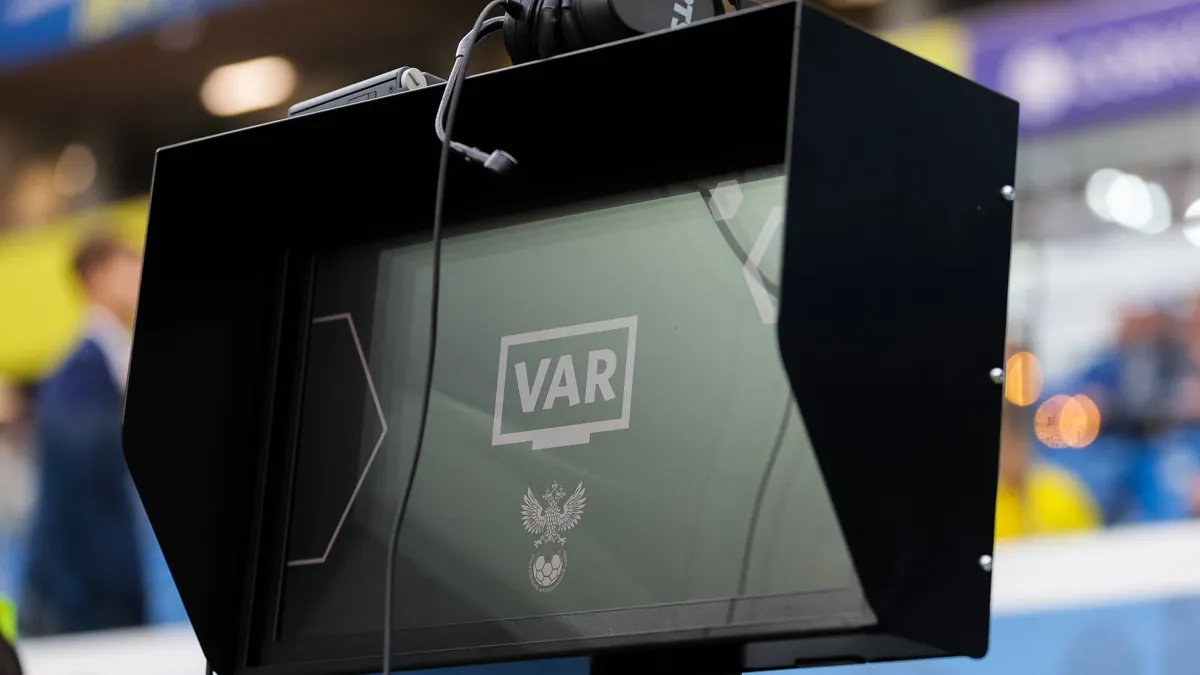
What is VAR in football? It stands for Video Assistant Referee: a qualified referee watching the match on screens in a video room, who alerts the on-field referee when a goal, penalty, direct red card or mistaken identity call is a clear and obvious error. The on-field referee still makes the final decision.
Related article: Premier League standings.
The VAR team checks every reviewable incident while play goes on, so most checks happen without stopping the match. Fans only notice VAR when it steps in, which is why it can feel like it appears out of nowhere. Watch the next match live on our football live score page and you will see the checks happen in real time. Offside is the call VAR gets asked about most, and our offside rule explained guide covers that law in full.
What Is VAR in Football and Who Runs It?
The VAR is a match official, not a machine. The team in the video operation room is a video assistant referee, an assistant VAR (AVAR) and a replay operator. In the Premier League, they all work from a central room at Stockley Park in London, watching every camera angle of the match.
The rules come from the International Football Association Board (IFAB), the body that writes the Laws of the Game. IFAB wrote VAR into the Laws on 3 March 2018, under one simple idea: minimum interference, maximum benefit. That means VAR stays quiet unless the referee has made a clear and obvious error or missed a serious incident.
What Can VAR Check? Only 4 Decisions
The answer to what is VAR in football also sets its limits: VAR can only look at four kinds of decisions. Everything else stays with the on-field referee, no matter how wrong it looks on a replay.
| Decision | What VAR checks |
|---|---|
| Goal or no goal | An offence in the build-up, the ball out of play, offside or handball before the goal |
| Penalty or no penalty | Whether the foul was inside or outside the box, a penalty wrongly given, or one that was missed |
| Direct red card | Denying an obvious goal-scoring chance, serious foul play, violent conduct, or abusive language |
| Mistaken identity | The referee books or sends off the wrong player |
Two kinds of calls work differently. Factual calls, like offside or inside versus outside the box, are judged as right or wrong. Subjective calls, like whether a foul was serious enough for a red card, only change when the error is clear and obvious.
How a VAR Review Works, Step by Step
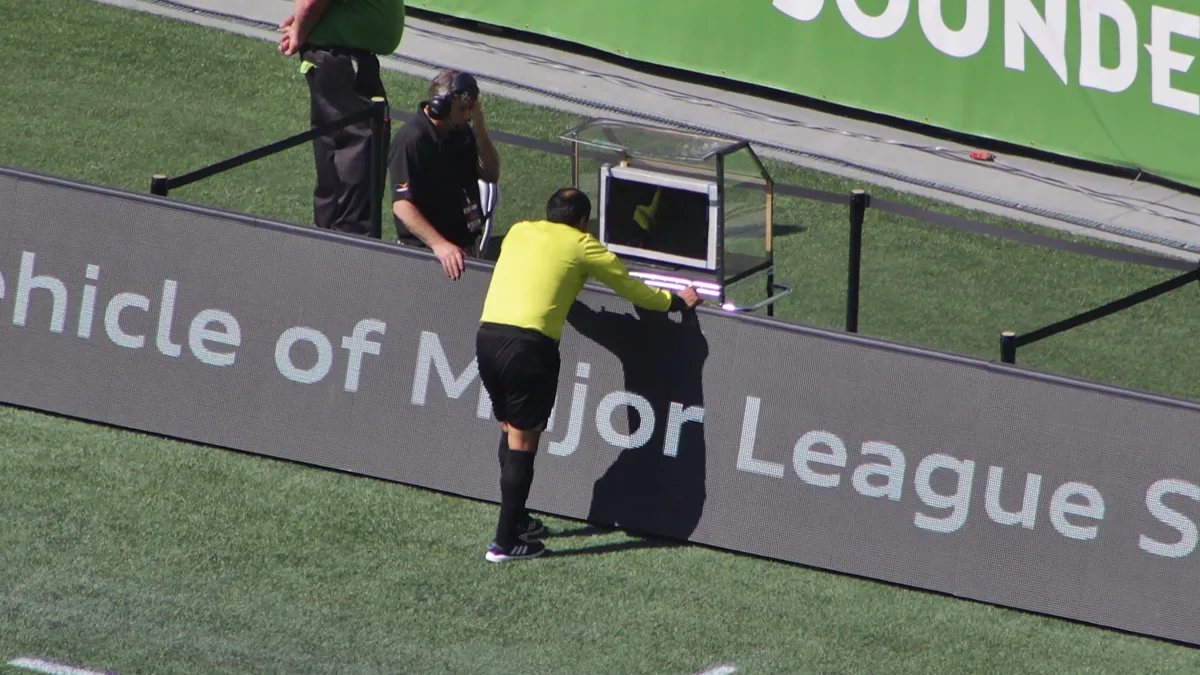
- The VAR silently checks every goal, penalty, red card and identity call as play goes on.
- If the VAR spots a possible clear and obvious error, the VAR tells the referee over the headset.
- The referee either takes the VAR’s advice or goes to the pitchside monitor for an on-field review.
- The referee makes the final call and signals it by drawing a TV rectangle with both hands.
- Play restarts with the corrected decision.
The referee’s first call stands unless the video clearly shows it was wrong. That high bar is deliberate. That is the heart of what is VAR in football: a safety net for howlers, not a second referee for every tackle.
VAR and Offside: Why the Lines Take So Long
Offside is where VAR is at its most exact and, for a lot of fans, at its most infuriating. Goals have been ruled out because a toe or an armpit was beyond the last defender, and the check can take minutes while the stadium waits.
The old method made it worse: officials drew the offside lines on the screen by hand, which was slow and left fans doubting the result. Semi-automated offside technology changed that. Tracking cameras follow 29 points on each player’s body, and a sensor inside the ball records the exact moment it is kicked, so the system draws the lines itself.
FIFA first used semi-automated offside at the 2022 World Cup in Qatar. The Premier League adopted it on 12 April 2025, first in Manchester City against Crystal Palace, after testing it in FA Cup fifth-round ties. It is quicker and more accurate than hand-drawn lines, and it has cut the longest waits.
One thing the technology does not settle: whether an offside player interferes with play. That call still belongs to the referee.
VAR History: From 2016 Trial to Every Big League
The short history below shows how quickly the answer to what is VAR in football changed from an experiment to a standard part of the game.
| Year | Milestone |
|---|---|
| Dec 2016 | First competitive use, at the FIFA Club World Cup |
| Mar 2018 | IFAB writes VAR into the Laws of the Game |
| Jun 2018 | First World Cup with VAR, in Russia; France win a penalty after a review in the final |
| 2019-20 | Premier League starts using VAR; La Liga, Serie A, Bundesliga and the Champions League already use it |
| 2022 | Semi-automated offside used at the World Cup in Qatar |
| Apr 2025 | Semi-automated offside starts in the Premier League |
What VAR Cannot Check
Knowing what VAR cannot do is part of understanding what is VAR in football, and the limits explain most of the arguments about it.
- Second yellow cards. VAR can only step in for a direct red card offence, so a wrong second yellow cannot be reviewed.
- Free kicks, corners, throw-ins and goal kicks on their own. The Laws do not allow restart decisions to be changed once play has restarted, so they cannot be reviewed.
- Fouls or handballs in midfield that do not lead to a goal or a penalty.
- Goal-line calls. Goal-line technology is a different system, not VAR. Hawk-Eye cameras judge whether the ball crossed the line. IFAB approved it in 2012, and the Premier League has used it since 2013-14.
Why Fans Still Argue About VAR
The first complaint is delay. Long checks break the flow of the game and kill goal celebrations, because fans wait to cheer until the VAR check is done.
The second is marginal offsides. A goal ruled out by millimetres feels wrong even when the call is technically right, and that feeling has never gone away.
The third is that “clear and obvious” is still a judgement call. Two similar incidents can get different outcomes, and leagues do not use VAR the same way: Premier League referees go to the monitor less often than referees in some other leagues.
The most famous failure came on 30 September 2023, when Tottenham beat Liverpool 2-1. Luis Diaz scored a good goal, it was ruled offside on the pitch, and the VAR wrongly thought the on-field call was a goal, so the error stood. The referees’ body apologised and called it a significant human error.
Even the critics agree on one thing: VAR has corrected far more howlers than it has caused. The arguments are about how it is used, not whether bad decisions should be fixed.
FAQs
Can VAR check a second yellow card?
No. VAR can only step in for a direct red card offence. If a referee shows a wrong second yellow, the decision stands and the player is sent off.
Does VAR check every goal?
Yes. The VAR checks every goal silently while play continues, looking at the build-up for offside, handball, a foul or the ball going out of play. The VAR only intervenes when there is a clear and obvious error.
Who makes the final decision in a VAR review?
The on-field referee. The VAR only advises, and the referee can accept that advice or go to the pitchside monitor. The referee’s call after the review is final.
Is goal-line technology part of VAR?
No. Goal-line technology is a separate Hawk-Eye camera system that judges whether the whole ball crossed the line. IFAB approved it in 2012, and the Premier League has used it since 2013-14.
When did the Premier League start using VAR?
The Premier League started using VAR in the 2019-20 season. Semi-automated offside technology followed on 12 April 2025, first in Manchester City against Crystal Palace.
Why does VAR take so long sometimes?
Offside line checks and pitchside monitor reviews take time, especially when the call is marginal. Semi-automated offside has cut the longest waits, but a close call still needs the referee to look at the screen.
Final Thoughts
So, what is VAR in football in one line? A video referee team that fixes clear and obvious errors in four decisions only: goals, penalties, direct red cards and mistaken identity. The on-field referee still makes the final call, offside is now faster with semi-automated technology, and the arguments today are about how VAR is used rather than whether it should exist.
Watch the next match live on our football live score page and see how the next VAR check plays out.
Sources: IFAB VAR protocol | Premier League VAR FAQ